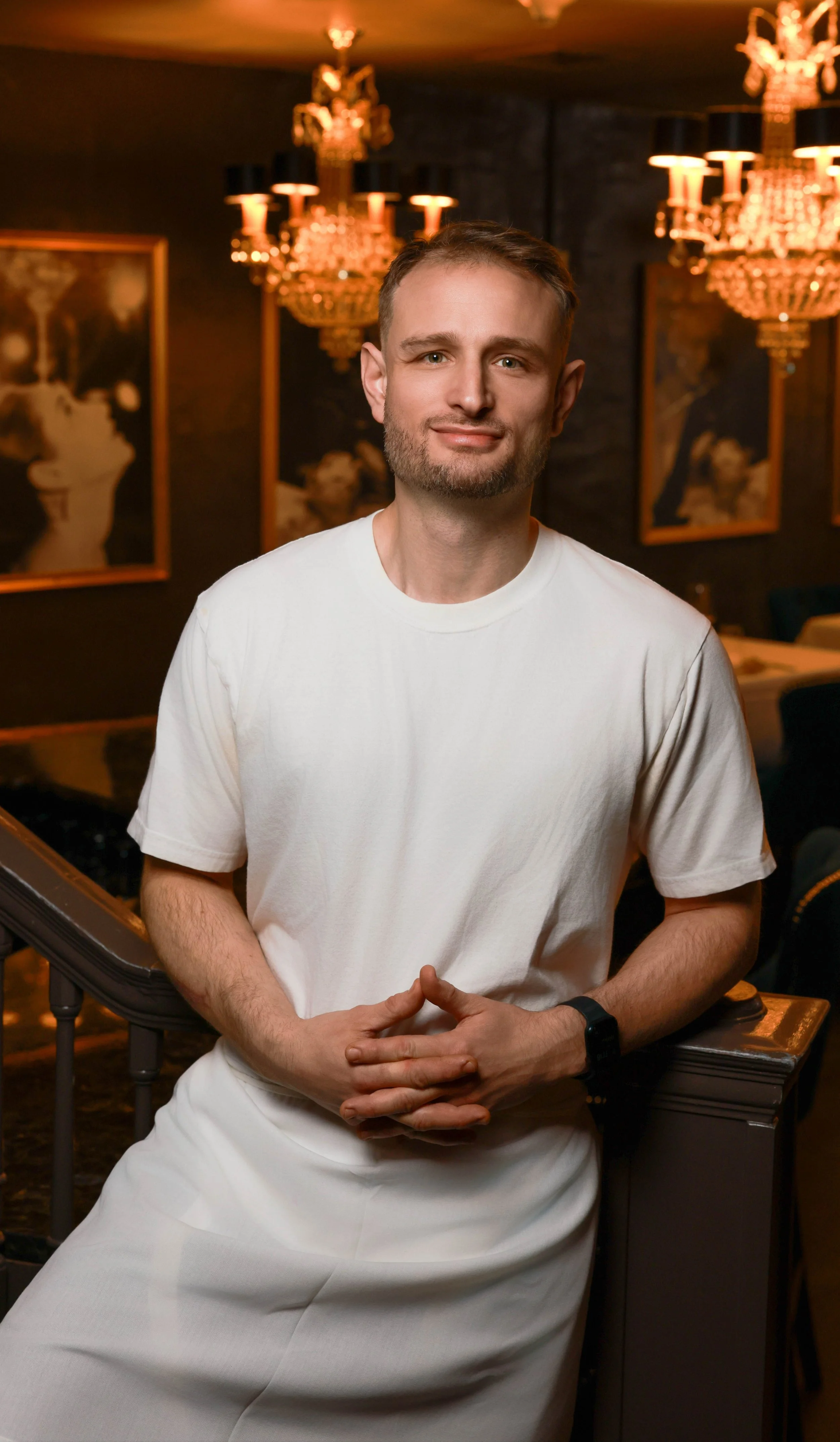
The Sweet Architecture of Renaud Besnard
At Josephine’s, dessert is not an afterthought. It is a final impression, a last note of refinement, and often, the moment a meal becomes memorable. Behind that experience is Executive Pastry Chef Renaud Besnard, whose work extends far beyond one dining room.
Based at Josephine’s, the largest kitchen and production space within the restaurant group, Besnard oversees the pastry programs for Josephine Downtown, C’est La Vie Bistro, The Belvedere Inn, and 401 Prime. Nearly every dessert served across those properties comes through his hands, his team, or his vision.
“I design the menu for every location,” Besnard says. “I try to have a different touch for each one.”
That distinction matters. Josephine’s, with its fine-dining sensibility and French-inspired cuisine, calls for a certain elegance. C’est La Vie Bistro leans more casual, with the feeling of a French bistro in Paris or Lyon. The Belvedere allows for a French-American approach, while 401 Prime demands desserts with a little more presence — richer, bolder, and suited to the scale of a steakhouse experience.
For Besnard, pastry is not about repeating one formula across four restaurants. It is about understanding the personality of each room.
At the bistro, for example, he might take classic French technique and weave it together with an ingredient more familiar to American palates. A cheesecake may begin with a French pastry foundation but incorporate cream cheese in a way that feels both recognizable and elevated. Peanut butter, too, can find its way into his work — not as a novelty, but as an ingredient transformed through technique.
“You can use peanut butter in fine dining,” he says. “You just have to transform it.”
That instinct — to refine without losing approachability — is central to Besnard’s style. His desserts are never built simply to overwhelm. He is not interested in excess sweetness or heavy-handed decoration. Balance is the measure.
“I’m not a very sweet person,” he says with a smile. “You would never try something from my kitchen that is overly sweet. I need balance — sweetness, bitterness, sourness, acidity. It needs to make sense.”
His preference leans toward desserts with lift and contrast: something bright, something dark, something that lingers without weighing down the meal. Grapefruit, with its sharpness and bitterness, is exactly the kind of ingredient he admires. Fondant, excessive icing, and overly heavy desserts do not interest him. His work is more restrained, more architectural, and more precise.
That discipline began in France.
Besnard grew up in the suburbs of Paris, in a small town not far from the city. He began his career in a local bakery and pastry shop, working there for several years while completing his culinary and restaurant training. From there, he moved into Paris proper, where the level of expectation changed quickly.
He spent roughly a decade working in some of the city’s most demanding kitchens, including positions with Michelin-starred chefs and in celebrated luxury hotels. His résumé includes time at the Ritz Paris and Le Bristol Paris, a palace hotel known for its exacting standards and three-Michelin-starred dining.
Before coming to the United States, Besnard’s professional world was almost entirely high-end restaurants and hotels. Fine dining shaped him. So did Paris. But opportunity, as he tells it, has always played a defining role in his life.
A chance meeting with a pastry chef in New York changed everything. Besnard was visiting the United States when the chef asked whether he would be interested in coming over professionally. The restaurant sponsored his visa and brought him in as a sous chef. What began as a one-year opportunity eventually became a longer chapter.
“Twelve, thirteen years later, here we are,” he says.
In New York, Besnard worked in a Michelin-starred restaurant in Times Square, a position that came with the pace, pressure, and energy of the city. But after five years there, and with a growing family, he began to feel ready for something different.
Once again, a meeting opened the door.
Through another chef, Besnard learned of a project in Lancaster. At the time, he knew little about the city and had never lived in Pennsylvania. Friends and colleagues questioned the move. Why leave New York? Why step away from that world?
Besnard decided to try it anyway.
“I did it for the family and for the experience,” he says. “Eight years later, I don’t regret a single second of it.”
Today, Lancaster is home. Besnard and his wife, whom he met in New York, have three daughters — two born in New York, one born in Pennsylvania. His life has moved from the outskirts of Paris to the intensity of Manhattan to the kitchens of Lancaster, but his work still carries the standards of the places that formed him.
Though he holds the title of chef, Besnard has always remained devoted to the sweet side of the kitchen.
“I only work in the sweets and baking field,” he says. “I never cook savory.”
He pauses, then adds with good humor that he believes he is a good cook anyway.
But pastry is his language. Baking, desserts, creams, textures, acidity, bitterness, and balance — this is where his imagination lives. Asked to name a favorite dessert to make, he resists choosing just one. Like many chefs, he finds the question nearly impossible.
It could be macarons. It could be bread pudding. It could be crème brûlée. It could be something entirely new.
“I really like everything I put out there,” he says.
That may be the clearest expression of his philosophy. Besnard is not chasing a single signature dish. He is building experiences — each tailored to its restaurant, each grounded in technique, each designed to please without pandering.
His desserts carry the polish of Paris, the adaptability of New York, and the quiet confidence of a chef who has found his place. At Josephine and beyond, Renaud Besnard is crafting more than finales.
He is shaping the last memory of the meal.
Make Chef’s Strawberry Tart.